Loading WebMarv

Fintech Engineering: From Friction to Sovereignty.
Market Friction Diagnostic
The Fintech Reality: Speed is Trust, and Legacy is a Liability.
In modern finance, latency isn't just a technical metric—it's a massive leakage of institutional trust. Most financial platforms lose 40% of potential accounts during the initial 4-second load. When a user is trusting you with their capital, a 'spinning loader' feels like a security breach. We solve the 'Technical Friction' that legacy banks ignore.
"Business owners spending millions on security while losing 1 in 2 customers to a slow onboarding page."
Onboarding Lag
4.2s
Target: 0.6s
Lead Drop-off
55%
Target: WebMarv Recovery: 85%
Manual KYC
15m
Target: WebMarv Automation: 10s
Technical Pillar Mapping
The Solution Architecture
Pillar 1: Visibility
High-Intent Search Domination
We research what your customers search (e.g., 'zero-fee international transfers') and ensure you own the #1 position, reducing CAC by 60% through technical authority.
Pillar 2: Revenue
Zero-Friction Account Funnels
Mobile-first, high-converting portals designed around one goal: turning a high-stakes visitor into a verified account holder in under 60 seconds.
Pillar 3: Automation
AI Compliance & Triage
Automated KYC and AML workflows that qualify leads and detect fraud patterns in real-time, 24/7/365.
Structural Differentiation
Agency Mindset vs. Engineering Sovereignty
Standard Agency
- Deliverable-based mindset (just tasks)
- Generic industry templates
- Fragmented data reporting
- Slow lead-response cycles
- Manual, repetitive workflows
WebMarv Engineering
- Outcome-based engineering (ROI focus)
- Bespoke technical forensic audit
- Unified data mesh across all pillars
- Sub-2s automated lead engagement
- Custom AI agents & process automation


Technical Deep Dive
Engineering Sovereignty
in Fintech Architecture.
A forensic analysis of the technical bottlenecks, compliance frameworks, and engineering solutions required to dominate the modern fintech landscape.
1.0 // Core Pillar
The Architecture of Trust: Solving the Onboarding Latency Crisis
In finance, latency is an institutional failure, not a technical metric.
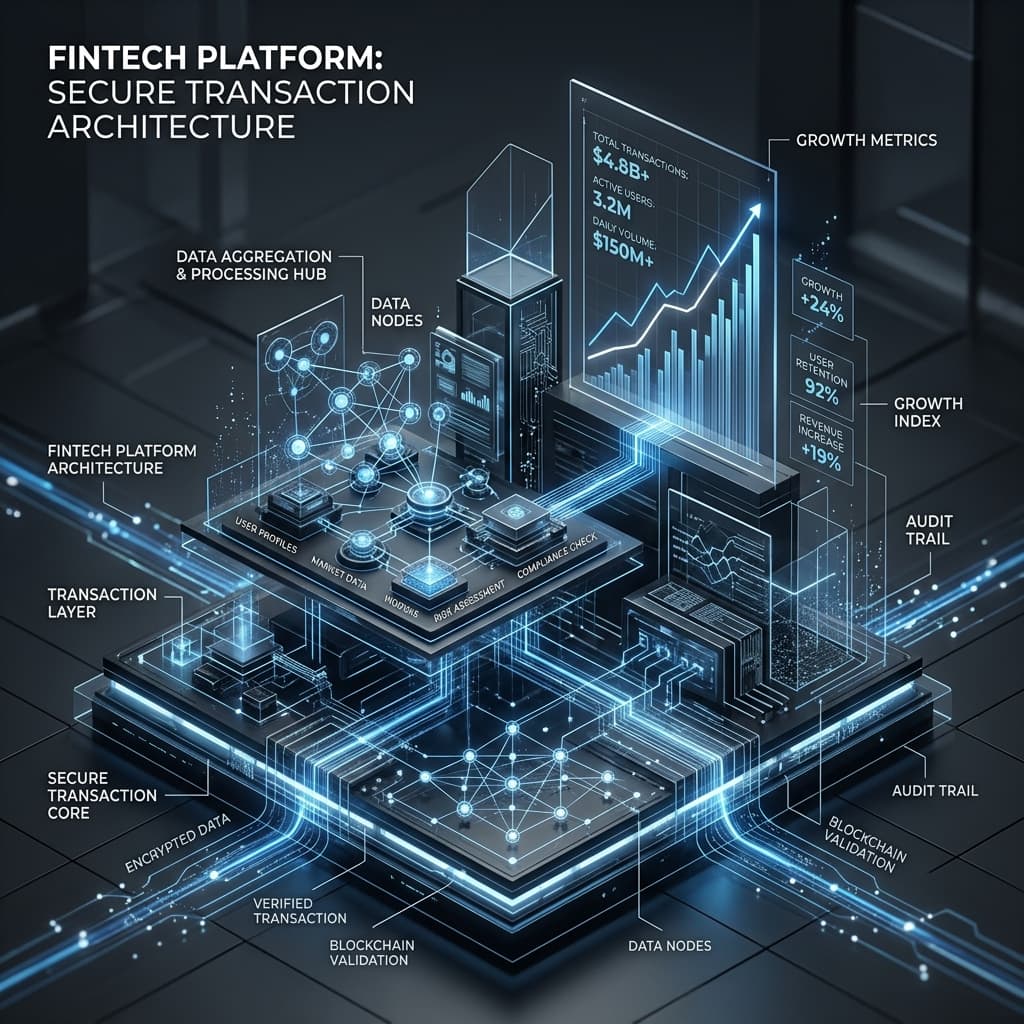
In the modern financial landscape, trust is no longer built solely through brand heritage or physical branches; it is built through the precision and performance of the digital interface. For a Fintech platform, a 4-second delay in onboarding isn't just a minor friction point—it is a massive leakage of institutional trust. Data indicates that high-stakes users associate 'spinning loaders' with security vulnerabilities. If your platform can't manage a simple page transition, why should they trust you to manage their capital?
At WebMarv, we treat latency as a security breach. Our 'Architecture of Trust' deployment for Fintech focuses on sub-second interactions powered by Edge Runtime and Next.js streaming. By moving the heavy lifting of data validation, regional compliance checks, and KYC orchestration to the global edge, we eliminate the round-trip lag that traditional banking cores suffer from.
We leverage HTTP/3 and QUIC protocols to ensure that packet loss in mobile environments doesn't compromise the onboarding experience. Our goal is to move the 'Aha Moment' of a financial product into the first 60 seconds of interaction, turning a high-stakes visitor into a verified account holder before the friction of legacy systems can trigger a bounce.
- Sub-600ms Time-to-Interactive (TTI) for global users.
- Edge-cached compliance logic to reduce server round-trips.
- Predictive pre-fetching of KYC data fields based on intent signals.
- Zero-latency state synchronization across multi-device onboarding sessions.

Diagnostic Signal
WebMarv engineering protocols for high-stakes fintech environments.
2.0 // Core Pillar
Compliance-as-Code: Automating KYC, AML, and PCI DSS
Regulations are not bottlenecks; they are solvable engineering equations.
The primary friction in Fintech growth is often the 'Regulatory Wall.' Traditional agencies treat compliance as a manual checklist; we treat it as code. We implement 'Compliance-as-Code' architectures where KYC (Know Your Customer) and AML (Anti-Money Laundering) workflows are orchestrated in real-time without human intervention.
By integrating agentic AI agents directly into the onboarding mesh, we triage users based on risk profiles in under 10 seconds. This isn't just about speed—it's about accuracy. Our systems utilize machine learning to detect 'Synthesized Identity' patterns that manual reviewers might miss, providing a defensive perimeter that starts at the first form field.
For data security, we engineer PCI DSS Level 1 compliant environments using isolated data vaults. Sensitive financial information is tokenized at the edge, ensuring that no raw data ever touches your central application server. This 'Sovereignty-First' approach reduces your audit scope and ensures that even in the event of a breach, the data remains computationally useless to bad actors.
- Automated KYC orchestration reducing verification time by 90%.
- Real-time AML screening against global PEP and Sanctions lists.
- Edge-based tokenization for PCI DSS compliance and data isolation.
- Immutable audit trails generated automatically for regulatory reporting.

Diagnostic Signal
WebMarv engineering protocols for high-stakes fintech environments.
3.0 // Core Pillar
API Sovereignty: Bridging Legacy Banking Cores
Wrapping the technical debt of the past in the high-velocity interfaces of the future.
The dirty secret of Fintech is that many modern 'Neo-banks' are actually built on COBOL or aging SQL databases that were never meant for the modern web. These legacy cores create 'Technical Friction'—delays in transaction visibility, rigid data structures, and brittle integration points. WebMarv specializes in building 'Sovereignty Bridges' that wrap these legacy systems in high-performance GraphQL layers.
This allows for real-time transaction visibility through WebSocket meshes, pushing updates to the user's screen in under 200ms. We move the complexity of legacy data transformation to a dedicated 'BFF' (Backend for Frontend) layer, ensuring that your front-end remains light, fast, and cinematic.
Whether you are integrating with a Tier-1 bank's legacy API or building a custom ledger on a modern distributed database, our architecture ensures that your user experience is never throttled by the limitations of the underlying infrastructure.
- GraphQL orchestration layers to unify fragmented legacy data sources.
- Real-time WebSocket meshes for sub-200ms transaction updates.
- Circuit-breaker patterns to prevent legacy core failures from cascading to the UI.
- Automated data transformation pipelines for cinematic financial reporting.
Diagnostic Signal
WebMarv engineering protocols for high-stakes fintech environments.
4.0 // Core Pillar
Fraud Detection at the Edge: Predictive ML Inference
Defense is most effective when it happens before the transaction is finalized.
Traditional fraud detection is reactive—it identifies a breach after the capital has moved. We move the defensive perimeter to the edge of the network. By deploying lightweight ML models (using PyTorch or TensorFlow Lite) directly to edge nodes, we perform real-time intent analysis on every user interaction.
We track micro-behaviors: typing patterns, mouse movements, and navigation sequences that indicate bot behavior or account takeover attempts. This 'Behavioral Fingerprinting' allows us to flag suspicious activity well before a fraudulent transaction is even initiated.
Our Edge Security mesh doesn't just block bad actors; it profiles 'High-Trust' users, allowing them to bypass traditional friction points like multi-step MFA for low-risk actions. This creates a 'Frictionless' experience for your best customers while maintaining a 'Zero-Trust' posture for everyone else.
- Real-time behavioral fingerprinting to detect bot and takeover patterns.
- Edge-based ML inference for sub-50ms fraud scoring.
- Adaptive MFA logic based on real-time risk assessment.
- Integration with global threat intelligence feeds for proactive blocking.

Diagnostic Signal
WebMarv engineering protocols for high-stakes fintech environments.
5.0 // Core Pillar
The Future of Financial Engineering: CBDCs and Web3 Integration
Preparing for the transition from digital banking to economic engineering.
The next phase of Fintech won't be about 'Better Apps'; it will be about 'Programmable Money.' As Central Bank Digital Currencies (CBDCs) and decentralized finance (DeFi) move into the mainstream, the technical requirements for financial platforms will shift from simple CRUD operations to complex smart contract orchestration.
WebMarv is already engineering for this transition. Our platforms are built with 'Modular Currency Logic,' allowing for the seamless integration of digital assets alongside fiat currencies. We build the bridges between traditional SWIFT/UPI rails and the next generation of blockchain-based settlement layers.
We are moving beyond 'Web Development' into Economic Engineering. We build the trust engines that allow for automated escrow, micro-payments at scale, and instant global settlement—all delivered through a cinematic, sub-second interface that masks the underlying complexity of the financial mesh.
- Modular currency logic ready for CBDC and stablecoin integration.
- Smart contract orchestration for automated escrow and settlement.
- Multi-rail payment routing (Card, UPI, SWIFT, Blockchain).
- Future-proofed architectures designed for 100% data portability.

Diagnostic Signal
WebMarv engineering protocols for high-stakes fintech environments.
Technical Methodology
The Fintech Tech Mesh
We deploy compliance-ready, high-performance architectures optimized for sub-second global interaction and data residency requirements.
Next.js 14 (App Router)
Edge Runtime
PyTorch (Fraud AI)
Stripe Integration
AWS Shield Plus

Technical Q&ACommon
Common
Questions
Addressing the structural and technical hurdles specific to your industrial sector.
We engineer all financial portals with 'Compliance-First' logic, utilizing tokenization and secure edge environments to ensure no sensitive data is leaked or stored unnecessarily.